
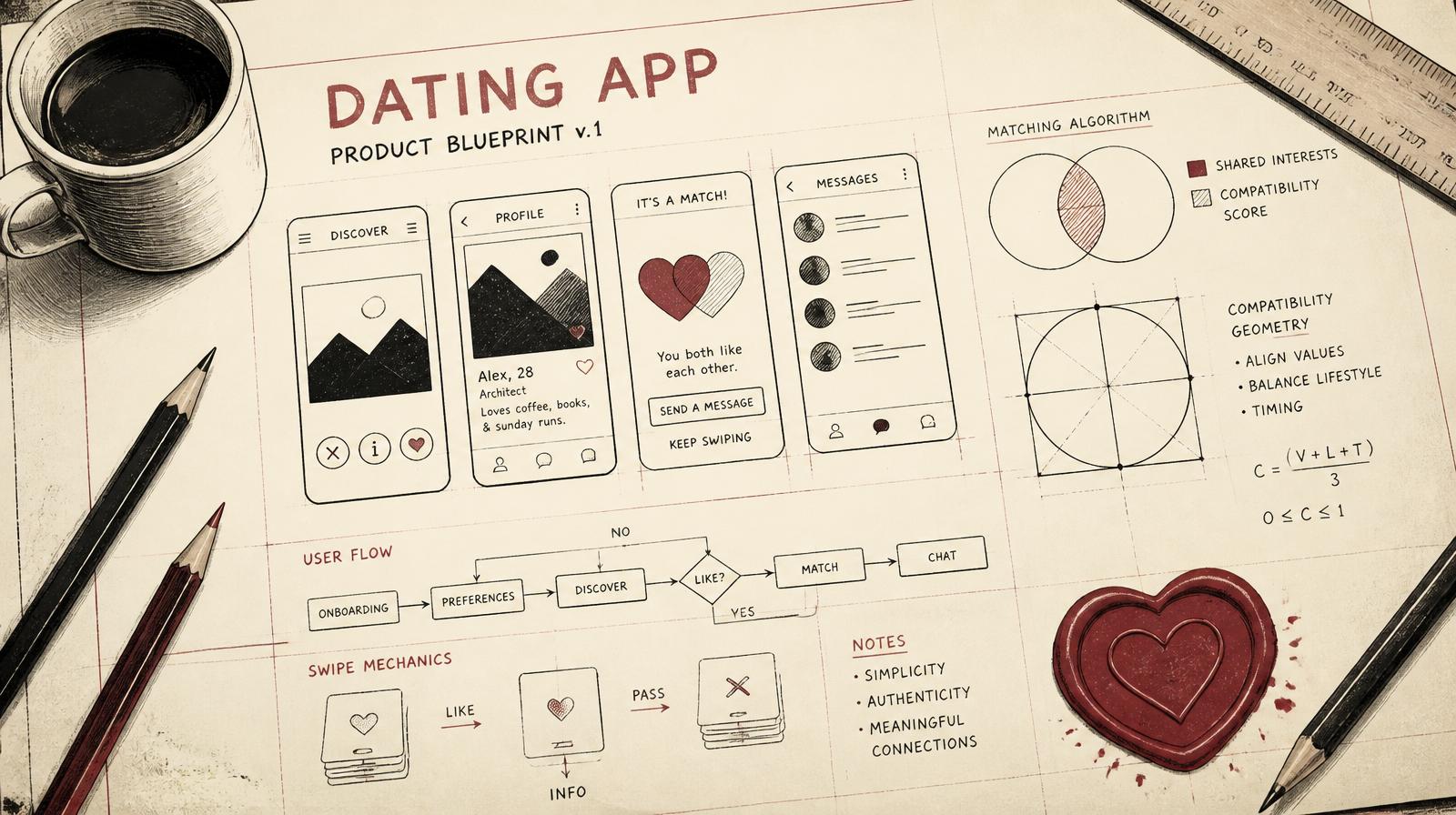
How to start a dating app
A founder's playbook for launching a dating business in 2026, from niche thesis and the cold-start problem to native apps, payments, and the first 1,000 users.
Reviewed by an operator. Last updated June 30, 2026. Led by founder and CEO Bill Alena, backed by a team of industry experts with over 100 years of online dating experience between them.
Most first-time founders ask "how do I build a dating app." The harder and more useful question is how to start a dating business. The app is the easy part. The business is what survives. This guide is for the founder who is serious about launching, written from inside the industry by operators who have built dating brands from zero to scale.
Start with a real thesis, not a feature list
The crowded part of the market is general-audience dating. The open part is intent. A genuinely intentional brand makes different choices, in positioning, product, monetization, and trust, from a brand that simply says it is serious. Before you pick a tech stack, write down three things. Who exactly is this for. What outcome are you helping them reach. Why are you, specifically, the right person to build it for them.
If your answer to "who" is "young singles," stop and narrow. The brands that work today win on a specific audience: a community, a faith, a profession, a life stage, a city, a shared value. Niche is not a smaller market. It is a defensible one. Tinder cannot out-niche you. They will not even try.
The "why you" question is the one most founders skip. The dating market punishes outsiders. If you do not know the audience from the inside, you will misread their language, their expectations, and the moments that build trust. Spend the first two weeks of your project talking to twenty real people in that audience before you draw a single screen.
Understand the cold-start problem before you fall into it
A dating product is a two-sided liquidity problem. With no users, there is no value. With a few users, there is no value because nobody finds a match. The crossover, where joining feels worth it, is unforgiving. Most apps die in month two because the founder ran a launch, brought in a few hundred users, and then watched them fail to find anyone within a week.
You can only beat the cold-start problem in three ways. Concentrate density in one city or one community, so a small total user count still feels alive. Seed one side of the market first, with paid work or partnerships, so the other side has someone to meet. Or buy your way in through paid acquisition, which costs more than founders ever budget for. Plan for whichever one you can actually execute. Hoping for organic growth on day one is not a plan.
Build, buy, or run on a platform
There are three honest paths to a live product.
You can build native code from scratch. Expect twelve to eighteen months and seven figures before you have an app that holds up to fraud, scale, and the app stores. You will hire iOS, Android, backend, payments, trust and safety, and devops, and you will rebuild the things every dating company has already built. Choose this path only if your product genuinely needs custom systems that no platform can support.
You can assemble a backend-as-a-service stack. Faster, but you still own integration, moderation, native publishing, payments, and every regulator question. Most teams underestimate how much of a dating business is the non-code part.
Or you can run on a white-label dating platform that already solves the unglamorous pieces. We built Dating Partners (datingpartners.com) precisely because most founders are blocked by infrastructure, not ideas. It gives you the matching engine, native apps, payments, moderation tooling, analytics, and the operational know-how, so you can focus on audience, brand, and economics. We are not saying this is right for everyone. We are saying it should be on your shortlist if your edge is the audience, not the engineering.
The non-negotiable stack
Whatever path you pick, a serious dating product needs these systems on day one. Skipping any of them is the most common reason apps stall.
Identity and verification. You need phone or email verification, ID checks for higher-trust tiers, and a strategy for catching duplicate accounts. Trust starts here.
Moderation. Automated image and text moderation, plus a small human review queue. Set the standard early. You will be judged forever by your first hundred bad actors.
Payments. Subscriptions, one-off purchases, refunds, retries, dunning, regional pricing, and dispute handling. Payments quietly decide whether you have a business.
Native apps for iOS and Android. We build, publish, and manage native Android apps for you, end to end. We build your native iOS app and work directly with Apple to get qualifying brands approved for the App Store. Native is not optional for a real dating product.
Push, email, and SMS. Lifecycle messaging is half of retention. Build the rails on day one, not after the third cohort.
Analytics that map to behavior, not vanity. Funnel from install to first match to first message to first date. If you do not measure outcomes, you will optimize for the wrong thing.
The app store reality
iOS and Google Play treat dating apps with extra scrutiny, and rightly so. The categories that get rejected are the predictable ones: under-eighteen risk, missing moderation, weak verification, unclear monetization. Plan for review like you plan for launch.
On iOS, Apple expects a verifiable trust and safety operation behind the app, not just words in the App Privacy section. Plan for a real submission, possibly several. We build your native iOS app and work directly with Apple to get qualifying brands approved for the App Store. Qualifying means a real product, a real moderation operation, and a brand the store can defend listing.
On Android, the bar is different but not lower. The wrong content moderation policy or a thin verification flow will block you. We build, publish, and manage native Android apps for you, end to end, because the publishing relationship is its own muscle.
We are also building a High Intent companion app that serves all our partners, with experiences targeted to each brand's users. It is in development. Treat it as a future option, not a launch dependency.
Make money without strangling growth
The honest answer on monetization is that there is no single right model in dating, but there are several models that work and one that almost never does.
Subscriptions are the default. They work because the user feels in control and the brand feels less predatory. Tier them on visibility, filters, and confidence signals rather than pay-to-message. Pay-to-message looks tempting and often kills the marketplace.
Consumables, like boosts and super likes, work when they amplify the user's intent rather than gating basic outcomes. They fail when they feel like a slot machine.
Premium features, like read receipts or who-liked-you, are durable revenue when the underlying matching is strong. They are a tax on weak matching when it is not.
The model that almost never works is heavy in-app advertising. It erodes trust in the most trust-sensitive category online.
Payments quality matters as much as price. Across our platform, dispute rates currently run under 2%, which is the difference between scaling and being shut down by the processor. If you build your own stack, model chargeback economics before you model revenue.
Dating App Unit Economics Calculator
Plug in your real numbers to size LTV, CAC payback, and the LTV to CAC ratio. Defaults reflect typical paid dating apps.
List price the paying user is billed each month.
Share of installs or signups that ever pay. Dating norm: 2 to 5 percent.
Share of paying users who cancel each month. Dating norm: 15 to 25 percent.
Blended cost to acquire one paying subscriber, including paid media and incentives.
- ARPPUper paying user, monthly
- $19.99
- ARPUacross all users, monthly
- $0.60
- Avg paying lifetime1 / monthly churn
- 5.6 mo
- LTV (gross)ARPPU x lifetime
- $111.06
- LTV : CAC3 : 1 is the working floor
- 4.44 : 1
- CAC paybackmonths to recover CAC
- 1.3 mo
This is an estimate. Real numbers depend on cohort behavior, gateway fees, refunds, and chargebacks. Use it to pressure-test your model, not as a forecast.
The first 1,000 users
A launch is not a press release. It is a deliberate liquidity build. Pick one geography or one community, write down the density you need (a useful benchmark is one thousand active users inside a ten-mile radius before a typical dater feels the app is alive), and design the launch backwards from that target.
Tactics that work consistently. Community partnerships, where you light up one organization, school, or city. Founder-led outreach, where you go where your audience actually gathers. Referrals built into the product, but only if you can pay them in something more valuable than a feature you should ship to everyone anyway.
Paid acquisition is real, but it is not a strategy on its own. CPI in dating ranges widely by geography and audience, and a meaningful proportion of paid installs will never message anyone. Treat paid as fuel for a fire you have already lit, not the lighter.
Press helps once, then never again. Plan a launch beat, but do not build a business on it.
Retention is the only growth that compounds
Acquisition will always cost something. Retention is where dating businesses are quietly won and lost. The metric to obsess over is not daily active users, which engagement-led apps optimize for. It is the rate at which new users reach a real outcome quickly, a message exchanged, a date arranged, a relationship started. We call this first-date rate at the platform level, and it correlates with everything that matters: word of mouth, reactivation, lifetime value.
The product implication is uncomfortable. Helping users leave the app faster, because they found someone, is good for the business. It builds the reputation and referral loop that pays back many times over. Engagement-led design, the kind that hides matches behind paywalls or rations attention, looks good in week one and corrodes the brand by month six.
Build cohort retention dashboards on day one and watch them weekly. If users are not active by day seven and not paying by day thirty, the funnel above them is irrelevant.
Trust and safety from day one
Trust is the product in dating. It is not a feature you bolt on after launch. The brands that survive treat safety as a first-class operation: clear community standards, strong reporting tools, fast removal, transparent decisions, and visible human accountability. The brands that do not, end up in headlines they cannot recover from.
Concrete commitments to ship on day one. A reporting tool that takes less than ten seconds to use. Automated detection for nudity, harassment, scam patterns, and minors. A human review queue with documented SLAs. A safety center with real content, not boilerplate. Background-check or verification options for the tiers that warrant it. A clear policy on banned users, with an appeals path, because fairness is part of trust.
The cost of trust is real. The cost of skipping it is the business.
When to raise money and when not to
The dating market is full of stories of founders who raised, scaled too fast, and discovered that paid acquisition alone cannot build a defensible brand. It is also full of bootstrapped operators who built quietly and sold for life-changing money. Both paths are real. Pick deliberately.
Raise if your thesis genuinely needs capital to reach liquidity. A geographic land grab, a network effect that compounds with scale, a team that cannot be assembled on revenue. Do not raise because the round is the goal.
If you do raise, raise from investors who understand dating economics. Generalist funds often misprice the category, either by demanding social-network growth curves that dating cannot deliver, or by underestimating how durable a well-run dating business can be. There are a handful of operators and funds who know the category cold. They are worth waiting for.
If you bootstrap, build for cash flow from month one. Subscriptions, honest pricing, low churn. A small profitable dating business is more durable than most people think.
We also help on this. Through our Capital practice, High Intent may acquire dating businesses outright, raise capital for owners who want to scale, sell brands on behalf of owners ready to exit, and source operators into opportunities. We disclose the dual buyer and advisor role in every conversation, because that is the only honest way to operate in this corner of the market.
A 90-day plan you can actually run
The first 30 days are about thesis and audience. Twenty conversations with real users. A written brand thesis, one page. A defined niche, geography, or community. A clear answer to who, what, and why you.
The next 30 days are about product and infrastructure. Pick the path: build, assemble, or run on a platform like Dating Partners. Lock in the non-negotiable stack: identity, moderation, payments, native, lifecycle, analytics. Submit the iOS and Android beta builds. Wire up cohort and funnel dashboards.
The final 30 days are about liquidity. Concentrate users in one place. Seed the harder side of the market. Ship a working referral loop. Launch with a beat your audience actually trusts. Read the cohort dashboards every Monday.
Ninety days will not give you a winner. It will give you a real, measurable, honest read on whether the thesis works. That is the only thing that matters in month four.
Key takeaways
- Niche is defensible. General-audience dating is not. Start with a specific audience and a real thesis.
- The cold-start problem is the deciding factor. Plan for liquidity, not for traffic.
- Build, assemble, or run on a platform. Pick the path that matches where your edge actually is.
- The non-negotiable stack is identity, moderation, payments, native apps, lifecycle, and analytics. None of these are optional.
- Trust is the product. Build the safety operation on day one, not after the first incident.
- Optimize for outcomes, not engagement. First-date rate compounds. Time-on-app does not.
Where High Intent can help
We are a parent company for the dating industry. We run a white-label platform (Dating Partners), an operator services practice across sixteen disciplines, a capital arm, and a network of consumer brands of our own. The team is led by founder and CEO Bill Alena (https://www.billalena.com), backed by a team of industry experts with over 100 years of online dating experience between them. Bill built myYearbook's revenue from $0 to $100M+ as CRO, ran all monetization at The Meet Group (NASDAQ: MEET) and helped grow it through four acquisitions, and grew Social Discovery Group revenue from $200M to $350M as Chief Investment & Growth Officer, leading M&A and a dating-only venture fund.
If you are starting a dating app, the most useful next steps are to read our Platform overview if you want a faster path to a live product, browse the Services practices that map to the gaps you do not want to staff yourself, and talk to our Capital team if funding, acquisition, or exit is on the horizon.
Frequently asked
 guideGetting a dating app approved on the App Store and Google Play
Why the stores scrutinize dating apps, what Apple and Google each require, the common reasons they reject, and how to be ready before you submit.
 guideHow to raise venture capital for a dating startup
Why raising for dating is hard now, who still funds it, what investors test, how the process runs, and the alternatives worth considering.
 guideBuild vs buy vs white-label: choosing your dating platform
The three ways to get a dating product, what each really costs, how to evaluate a white-label vendor, and the one factor that should decide it.