
The Funding Conversation No One in Dating Will Have With You
Every few weeks, someone asks me to help them raise money for their dating app. After twenty-five years on both sides of the table, here is the honest version of that conversation, and why it is more hopeful than the headlines.

From the Editor.
very few weeks, someone finds their way to me with the same ask: help me raise money for my dating app. They have a deck, a demo, sometimes real early traction, and almost always a number already in their head for the round they're about to close.
I slow that conversation down. The honest version of it is not the one they came to hear, and after twenty-five years in this industry, on both sides of the table, the honest version is the only one I'll give you.
Here's the good news up front: the honest version is more hopeful than the headline. The catch is that it asks you to build a different company than the one in your deck. So we start with the hard part, because you can't get to the opening without walking through it.
The arithmetic nobody puts on a conference slide
There are roughly 4,500 dating companies in existence. Fewer than 500 have ever raised a single outside dollar. Around 130 reached a Series A or beyond. And in the entire recorded history of the category, exactly one became a unicorn.
One.
Venture investment into dating fell about 59% in 2025, and new company formation has fallen off a cliff. If your plan depends on being the rare exception that raises a big institutional round, know exactly how rare that exception is before you bet two years of your life on it.
But read those numbers again, because they're not the obituary everyone treats them as. They're a map of where the easy money already died, and where the disciplined operator now has room to move.
The VCs aren't being unfair. It was never the right money anyway.
It's tempting to believe the money dried up because investors are short-sighted. They're not. They learned the model, and the model is genuinely hard for venture.
Dating sits on the same quiet no-list as games and gambling, a default pass for a lot of funds before they read your first slide. The reason is structural: your product succeeds by losing the customer. Build the best dating experience ever made and you've engineered your own churn, because your happiest users leave to go be in a relationship. Add acquisition costs that climb every year, network effects that are stubbornly local, and the cold-start problem that has killed wave after wave of apps, and you can see why a generalist VC underwriting power-law returns takes a pass.
Here's the reframe most founders miss: that doesn't mean your business is bad. It means venture was never the right fuel for it. Some of the best dating businesses in the world should never have raised institutional money at all. Stop treating ‘fundable by a VC’ as the test of whether you have something real. It isn't.
The incumbents are retreating. That's your opening.
Now the part that should excite you.
The category still makes real money, more than six billion dollars in revenue in 2024, with the top apps posting record monthly revenue in 2025. People haven't stopped paying for connection. That demand is intact.
What's changed is that the giants are pulling back. Bumble's market cap is down roughly 90% from its peak. Its founder had to come back to run it, and it cut nearly a third of its staff. Match laid off 13% of its workforce, and across the category the incumbents are slashing the marketing spend that used to bury every new entrant. Eighty percent of younger users say they're burned out by swiping.
Look at what that actually is: a massive, paying, deeply dissatisfied audience, and a set of incumbents who are contracting, cutting, and too busy defending their own numbers to chase the next idea. That is not a dying market. That is close to the best set of conditions a focused, creative new entrant could ask for. Fatigue at the top of a six-billion-dollar category isn't a warning sign. It's an opening.
Fatigue at the top of a six-billion-dollar category isn't a warning sign. It's an opening.
Creativity is the edge. See Thursday.
The operators who win right now are the ones who read these conditions and adapt, instead of pitching the 2019 playbook into a 2026 market.
Take Thursday. The London startup raised £2.5 million in 2021 on little more than a sharp anti-swipe twist: the app only worked one day a week. It grew to around two million users. Then dating-app fatigue caught up with the whole sector, and rather than ride the model down, the founders did the thing most teams are too attached to attempt. They walked away from the app almost entirely and pivoted into in-real-life events: ticketed singles gatherings, then travel and lifestyle built around them. The bet paid off. The company now calls itself the world's largest IRL dating brand, and in early 2026 its co-founder announced it had reached a $50 million valuation, with a fresh raise underway and a stated ambition of $500 million within five years.
You can debate the execution. You can't debate the instinct. They read the room, saw where the energy was actually going (offline, into real-world experiences), and moved the business there. I think IRL is going to be one of the defining shifts in this industry over the next few years, and I'll come back to it in its own piece. The lesson for any founder reading this: the opportunity isn't in copying what got funded last cycle. It's in seeing where daters are actually going and getting there first.
What actually works
So what do you do with all of this?
Reinvent the format, don't reskin it. The swipe is exhausted. Building another Tinder with a twist, or another Tinder for a narrower crowd, isn't a strategy. It's a slower way to lose. The dead end here isn't broad versus niche; it's derivative versus creative. Broad can still work if someone cracks it in a genuinely new way, the way Thursday cracked broad with real life. Niche can work too. What won't work is one more swipe clone of any size. The opening belongs to the people willing to rethink how matching actually happens, and the test of whether they've found it is real, repeat engagement, not installs you rented with ad spend.
Make money. This is the whole game now. Profitability is the new fundability. Charge early, keep your burn low, get to cash flow, and build something that doesn't need the round it's asking for. Cash flow buys the one thing most founders in this category never get: the freedom to grow the business the way you want, on your own timeline, and, if a round ever does come, the leverage to take it on your terms instead of someone else's.
Find money that already believes in dating. Generalist VCs pass on category alone, and no deck will change that. Operator-angels and strategics who've lived the churn math won't. Spend your time there.
Stop building for an exit. I mean this plainly. A meaningful exit is brutally hard right now unless you're very big or very profitable, and the one historical acquirer in this category is busy building in-house rather than shopping. So take the exit out of your plan. Keep it in the back of your mind as a someday outcome, never as a near-term objective. Build a business that makes money. Get big enough or profitable enough, and the exit will come find you. Design for the profit, not the payday, and you'll have a real company either way.
Why I'm telling you this
Nobody at the top of this industry is going to say any of this out loud. The people with the biggest platforms in dating have the most to lose by admitting how hard it's become, so the message that gets repeated is the comfortable one: keep building, keep raising, your round is just around the corner. The quiet part, the part that would actually help you, goes unsaid.
I'll say it, because the truth is better than the comfortable version: for the right operator, this is one of the best moments in a decade to build in dating. The tourists are leaving. The incumbents are retreating. The users are hungry for something better and still willing to pay for it. What's required is that you understand the space clearly enough to build for the market that exists, not the one the last cycle promised.
Do that, and the opening in front of you is real, and wide open. That's not a pep talk. That's the math, read correctly.
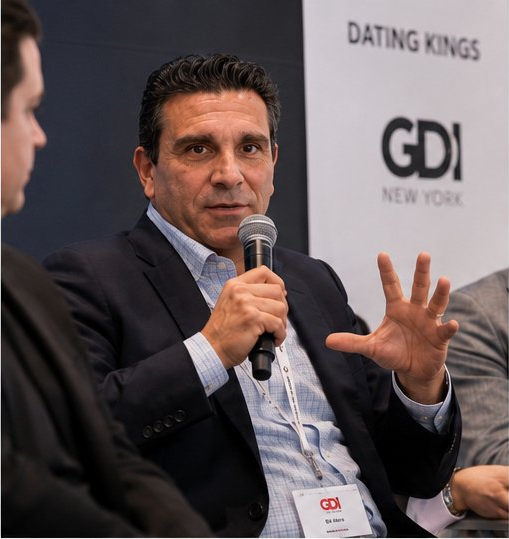
Bill Alena
Bill Alena is the founder and CEO of High Intent Media. He has spent twenty-five years building and investing in dating companies, on both sides of the table.
He built myYearbook's revenue from $0 to $100M+ as Chief Revenue Officer. He ran all monetization at The Meet Group (NASDAQ: MEET) and helped grow it through four acquisitions. As Chief Investment & Growth Officer at Social Discovery Group, he grew revenue from $200M to $350M and led the company's M&A practice and a dating-only venture fund.
He founded High Intent to give operators in the dating industry the honest news, the platform, the services, and the capital they have never had access to from one place. He writes The Editorial weekly, on the business of dating, from an operator's chair.
Daily industry headlines, curated for operators.
M&A, funding, product, policy, and earnings. Free to read, never sponsored.